Guardians of the Monarchs
Designing Child-Led Learning Experiences for Environmental Stewardship

Project Details
Overview
Role
UX Research Lead, Prototype Development, Learning Experience,
Content, & Systems Designer
Timeline
Jan - Apr 2025
Team
Audrey Reiley
Julieta Montealegre
Yilin Yi
At Phipps Botanical Gardens & Conservatory, an immersive, child-led adventure is designed to promote environmental stewardship by deepening the understanding of ecological interdependence.
The program follows the migration journey of the monarch butterfly, utilizing interactive storytelling and hands-on activities to engage families with children ages 4 to 12. Through this approach, participants explore and learn about the environmental connections along the butterfly’s journey.
The Challenge
Research reveals children are experiencing an "extinction of experience" with nature, particularly in urban environments. This disconnection threatens both developmental outcomes and future conservation efforts, as limited nature contact weakens environmental values and undermines conservation support as these children mature into adults. Phipps Botanical Gardens, while offering beautiful displays, struggles to create meaningful engagement between families and the ecological narratives behind these plants.
Visiting families exhibited the following patterns: Parents want to support their children's learning but often remain passive during visits, lacking confidence in how to facilitate deeper engagement. Children are drawn to visually compelling elements, but they need guidance to form meaningful connections with exhibits. Families encounter limited opportunities to develop their understanding of native flora and its relationship with migratory species. Even when parents value Phipps and participate in activities, they don't identify as environmental stewards or recognize clear pathways for action.
This reflects the broader challenge of changing environmental awareness into specific behaviors, especially when families lack opportunities to learn and explore nature together in ways that build mutual support and shared environmental understanding.
Primary Audience & Context

After researching multiple stakeholders, we identified families with children ages 4–12 visiting Phipps Botanical Gardens as our target audience. While educational programs exist at botanical gardens, there's a notable gap in immersive experiences that connect children to monarch butterfly conservation through active participation. This gap presents an opportunity for a child-led approach to environmental education.
Model I created illustrating parent-to-child transmission of environmental values and ecological identity formation
Families visiting Phipps face a distinct challenge: parents seek experiences balancing education and entertainment, while children possess natural curiosity but struggle to engage with traditional plant exhibits. Research shows that parental values transfer to children bidirectionally - children's nature experiences can actually influence parental environmental values. Children at this developmental stage are forming environmental attitudes that will shape their future relationship with nature, and positive early experiences increase likelihood of lifelong environmental stewardship.
Our Guardians of the Monarchs experience complements Phipps' mission to "inspire and educate all with the beauty and importance of plants" while addressing limited opportunities for child-directed, interactive learning about ecological relationships. The program creates an environment that promotes exploration, delivers age-appropriate challenges, and enables children to lead their learning journey through four interactive stations distributed across Phipps' spaces, using the monarch's migration as a unifying narrative that connects families to conservation action.
Significance of the Topic
Early Environmental Education
The monarch butterfly functions as an ideal ambassador species for distinct reasons:
-
The monarch’s dramatic metamorphosis and continental migration make it visually distinctive across continents
-
Its ecological role creates a direct connection to native plants that can be cultivated in backyards, providing a concrete pathway to environmental stewardship
-
The monarch's declining habitat presents a conservation challenge that people can meaningfully affect, giving them a sense of agency in addressing environmental concerns
Environmental education for children represents a crucial intervention point for developing lifelong conservation values. Monarch butterflies serve as a well-known symbol of broader environmental stewardship, as their migration story demonstrates how local actions can impact global ecosystems, transforming abstract ecological concepts into concrete, emotional experiences that build environmental identity during childhood - foundational connections that are difficult to establish later in life. Without these early interventions, the situation risks hindering intergenerational learning, where children's conservation enthusiasm can positively impact adult behaviors and amplify environmental action.
Why the Monarch?
Design Goals
Primary Objectives
-
Let children lead learning, with parents as supporters
-
Create multisensory activities that encourage active exploration
-
Highlight ecological links between monarchs and native plants
-
Suggest practical conservation actions for families
-
Engage families by letting children lead exploration in botanical gardens
Ecological Symbiosis
Learning Goals

Refining our team's design goals and learning objectives
Participants will identify mutually beneficial relationships between monarchs and milkweed, understanding how these partnerships support ecological balance and connect to broader ecosystem health.
Conservation Awareness
Participants will recognize threats to monarch populations, articulate specific actions they can take to support conservation, and understand how these actions connect to wider environmental protection efforts.
Active Stewardship
Participants will demonstrate practical conservation skills through hands-on activities and express intentions to implement these practices beyond their visit, recognizing how individual actions contribute to community-based conservation.
Place-based Connection
Participants will establish personal connections to the monarch's journey through immersive experiences that highlight relationships between humans and native plants, creating emotional investment in conservation that deepens their connection to nature.
Design Solution
Structure
The structure of our framework is built around a seasonal migration narrative that follows the journey of the monarch butterfly across four phases — Fall, Winter, Spring, and Summer. Each phase is represented by an interactive station anchored in one of the four core learning goals from our framework: Explain, Empathize, Interpret, and Apply.
Children enter a Magic Circle — a safe, imaginative learning environment — where they momentarily step out of everyday life and engage with context-rich, story-driven challenges. Within each station, learning is scaffolded using the CCAF model (Context, Challenge, Activity, and Feedback) to support deep, embodied understanding. For example, a child might encounter a real-world context (e.g., deforestation), engage in a challenge (e.g., role-play a conversation with a farmer), complete an action (e.g., build an argument or create a stewardship tool), and then receive feedback either from a parent, the environment, or a takeaway prompt. These approaches draw from and augment established design learning methods.
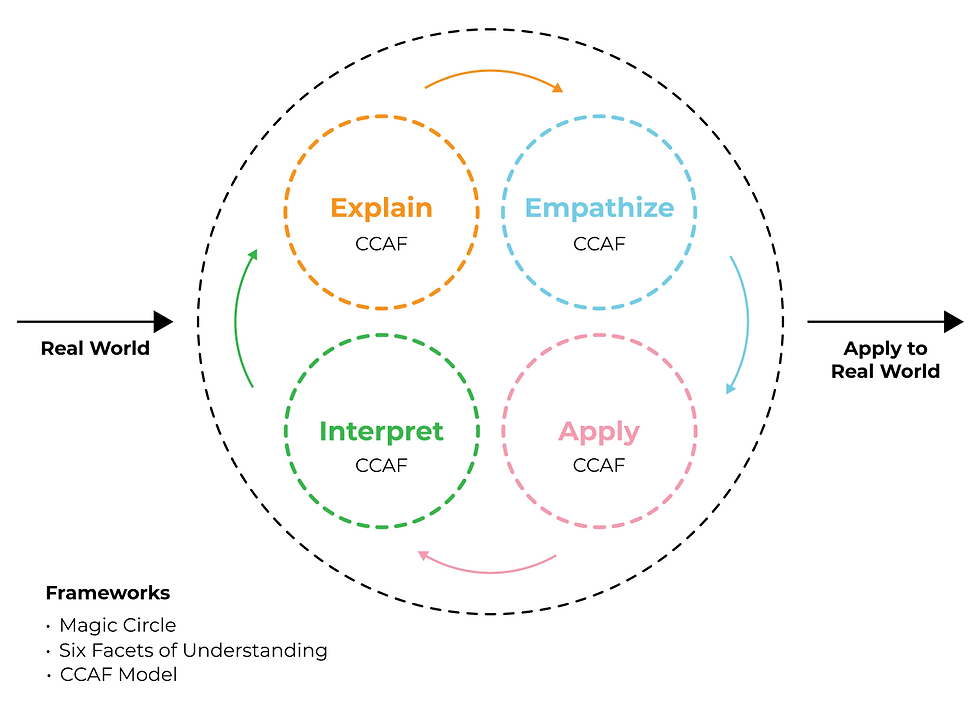
Framework illustrating the learning journey from real-world environmental contexts through four experiential stations back to real-world application
More detailed scenarios are as follows:
-
Fall Station: children explain butterfly migration through movement-based activities, exploring the seasonal triggers and distances involved.
-
Winter Station: children empathize with both monarchs and a role-played farmer, engaging in a convincing dialogue about balancing nature and livelihood.
-
Spring Station: they apply environmental stewardship by creating biodegradable pots after learning about monarchs’ dependence on local plants like milkweed.
-
Summer Station: they interpret how animals and plants interact for survival, using discovery-based panels that reveal surprising defense strategies.

Journey map showing the complete experience across four seasonal stations, tracking child actions, parent roles, emotions, and learning outcomes throughout the monarch migration narrative
These stations are not rigidly linear; while a narrative arc exists, the experience is intentionally flexible, allowing children to explore at their own pace or leave the journey at any point. The scenario structure is therefore both sequential and open, offering a child-led adventure that bridges imagination and real-world action.


Design & Prototypes
Onboarding
Introduction Poster
At the entrance at Phipps, a poster would encourage visitors to engage in our learning experience.
(Left to right) Stamp card & navigation card
Audio Guide for Children
At the entrance, caregivers will be instructed to scan a QR code to access an audio guide for children. Children are guided through the experience by an interactive audio guide, narrated by a Monarch Butterfly named Buffy and Caterpillar named Katie. These characters offer instructions, encouragement, and story-based prompts that explain what to do at each station, when to collect a stamp, and how to reflect using the Takeaway Card.
This audio guide ensures accessibility for children who cannot yet read independently.

Stamp & Navigation Card
At the ticket desk, children receive a role-play kit to utilize during the experience containing a vibrant Monarch Journey Stamp Card featuring station icons on one side and a migration map with station locations on the other. Children are encouraged to take the lead, guiding their caregivers through the experience while stamping their stamp card at each station.

Guardian role-play kit with integrated material storage for program participants

QR-enabled audio guide providing accessibility
Welcome poster to engage visitors and introduce the educational experience


Takeaway Cards
At the end of each station, children collect a Takeaway Card. The front of the card provides relevant information to the station they are currently at, while the back of the card poses a prompting question that relates to the next station in the experience.
Poster for Parents
At each station, we provide a parent-facing poster that offers context about the ecological theme and suggested prompts. These posters help guardians support their child’s understanding and respond to questions without taking control of the activity.
Station-specific takeaway cards corresponding to seasonal phases: fall migration (orange), overwintering (blue), spring migration (pink), and summer station (green)
Educational signage for each seasonal station, organized by corresponding color scheme: fall migration (orange), overwintering (blue), spring migration (pink), and summer station (green)
Design & Prototypes
Core Experience Components
Narrative-Driven Station Design
Each station is structured around a specific season (Fall, Winter, Spring, Summer) and corresponds to a distinct learning goal, Explain, Empathize, Interpret, or Apply, derived from our conceptual framework. These goals guide the emotional and cognitive depth of the experience.


Design & Prototypes
Fall Station
Following the audio instructions, children will learn information about Monarch migration from Pittsburgh to Mexico. Here, they will experience a flight simulation that teaches butterfly flight behaviors and how they conserve energy through their utilization of thermals and their ability to glide.
Learning Objective — Explain
Children will be able to explain how migratory species like the Monarch Butterfly use different flight modes to balance long-distance travel and energy conservation.
Station Activity
Children will use physical wind-up butterfly toys to observe how butterflies flap and glide their wings. They will also be able to place paper butterflies in a tube that is activated by pressing a button, which will demonstrate how monarch butterflies use thermal air currents to travel at high altitudes.
The front (right) and back (left) of this card provide prompts to help caregivers understand their role in the experience
This mockup shows the Fall Station integrated into Phipps' Sunken Garden room,
with real designed station elements digitally rendered into the authentic environment

Learning Objective — Empathize
Children will be able to empathize with the environmental needs of migratory species like Monarch Butterflies and the real-world challenges faced by people who depend on natural resources, such as farmers, when making stewardship decisions.
Talking with the butterfly in audio guide describing the challenge they face, Children will learn about the the unique microclimate monarchs need for overwintering through interacting with a diorama and exploring the space around Phipps to see if it has similar characteristics to my overwintering habitat.
Station Activity
The activity for this station will focus on a role play challenge where children will act as a park ranger and their adult will roleplay as a farmer who wants to cut down trees in the forest to feed their family.
Children will have thirty seconds to present the farmer with alternative income sources using prompt cards.
This mockup shows the Winter Station integrated into Phipps' Orchid Room space, with real designed station elements digitally rendered into the authentic environment.

Through an audio guide featuring a butterfly narrator, children learn about monarchs' unique overwintering microclimate needs by interacting with a diorama and exploring Phipps to identify similar habitat characteristics.
Overwintering Station
These cards provide conversation prompts to encourage children to discuss alternative solutions with the farmer
Spring Station
Through an audio guide featuring Katie the monarch caterpillar, children will learn about monarch butterflies' spring migration from Mexico to Pittsburgh.
A magnified display will help them explore how monarch butterflies and milkweed plants depend on each other throughout the butterfly's life cycle. This station emphasizes the critical relationship between monarchs and milkweed—their exclusive food source and habitat during development.

This mock up shows the Spring Station integrated into Phipps' Discovery Pavilion and showcases a translucent etched glass panels placed in front of a milkweed plant so visitors can view the life cycle of the monarchs' host plant and explore their interdependent relationship with milkweed
Learning Objective — Apply
Guided by Katie, the monarch caterpillar, in the audio guide, children will learn information about Monarch butterflies' return migration from Mexico to Pittsburgh in spring. They will explore the interdependence between milkweed and monarch butterflies’ life cycle on a magnified display.
The station highlights the critical relationship between Monarchs and milkweed plants - their exclusive food source and habitat throughout development.
Station Activity
Upon learning about the symbiotic relationship between monarch butterflies and milkweed as their primary food source, visitors will translate this knowledge into conservation action by creating their own biodegradable origami containers to support native and migratory species.
Biodegradable planting station where visitors make their own pots and cultivate milkweed seeds to support monarch butterfly conservation

Summer Station
Katie the caterpillar is trying to protect herself from a predator. Children will compare other insects defense mechanisms as well as their previous Milkweed knowledge to understand how Monarch caterpillars defend themselves.
This mockup shows the Winter Station integrated into Phipps' Tropical Rainforest space, with real designed station elements digitally rendered into the authentic environment.

Learning Objective — Interpret
Children will be able to interpret how animals and plants interact in nature, recognize the mutual benefits between species, and understand the crucial role that plants play in supporting animals’ survival strategies — such as providing food, defense mechanisms, and signaling to predators.
Station Activity
Children will be prompted to explore the different defense mechanisms used by monarch butterfly caterpillars for protection. Interactive signage will introduce a range of insect defense strategies that when lifted will reveal which of these are employed by monarch caterpillars.
Flip-up panels invite children to explore five insect defenses and reveal whether monarch caterpillars use each strategy to survive

Final Station
At the end of the experience, children who complete their stamp card are rewarded with a take-home prize:
a choice of native seed packets to plant at home. Visitors can also access information from the Grow Pittsburgh website to locate community gardens in their neighborhoods as an option for those who lack adequate space or the ability to plant native species at their residence.
This closing interaction not only reinforces stewardship beyond the exhibit, but also encourages return visits for those who have not yet completed all four stations.
Research & Discovery
We conducted extensive research to understand family dynamics in botanical garden settings and identify opportunities for meaningful environmental education. Our approach combined observational research with participatory activities to uncover both explicit preferences and implicit behaviors.
User Research Methods
Site observations at Phipps to understand family behaviors and spatial dynamics.
Visual storytelling activity with children using card prompts to identify which types of activities create the strongest connection with both children and parents through effective content presentation and engagement methods.

My team members preparing our activity prompt cards for user research
Parent surveys exploring attitudes toward child autonomy, their perceived role in learning experiences, and preferred family engagement formats.
Speed dating sessions with storyboarded concepts for peer and stakeholder feedback.
User testing with prototypes to validate interaction clarity.

User testing final prototypes with Phipps visitors at the Learning Center
Key Insights
Site Observations
-
Parents naturally follow and respond to their children's interests rather than leading
-
Their engagement is driven by their child's attention and enthusiasm
-
Families spend more time in spaces intentionally designed for collaboration
-
Children are strongly attracted to visually and physically engaging elements (color, movement, sound)
Visual Storytelling Activity with Card Prompts
-
Clear preference for realistic imagery over cartoon illustrations when selecting exploration tools
-
Enthusiastic gravitation toward hands-on tools (magnifying glasses, binoculars) indicating desire for active discovery
-
Natural excitement for interactive, scenario-based learning approaches
-
Some demonstrated prior knowledge about monarch butterflies and migration, showing readiness for deeper engagement
Parent Surveys
-
Strong preference for taking supportive, background roles while allowing children to lead exploration
-
High comfort and confidence levels when participating in child-directed activities
-
Belief that checking in at guided stations would be most effective for staying engaged without taking control
-
Desire to support their children's learning but often lack confidence in how to facilitate deeper engagement
Speed Dating
-
The experience needed clearer navigation cues matching each station's visual identity to prevent confusion
-
Activities should prioritize tactile, hands-on experiences over digital interactions
-
Physical, sensory-rich stations that invite touch and movement align better with children's natural exploration style
-
Real-time discovery elements are preferred over screen-based interactions
User Testing
-
Children needed clearer prompts and task cards to understand next steps after audio stories
-
Parents were uncertain about their role and when to offer help without taking over
-
Experience lacked sufficient scaffolding at key interaction touchpoints
-
Initial spatial navigation between stations was difficult for younger children despite color-coded signage
These findings validated our approach of designing a child-led experience that leverages natural curiosity while providing clear guidance systems and meaningful support roles for parents.
Challenges & Solutions
During the Guardians of the Monarchs design process, we faced several key challenges that required iterative problem-solving and user-focused solutions.
Creating Clear User Interactions
The Challenge
User testing showed children felt lost after audio stories and parents were unsure when to help without taking over.
The Solution
We developed a comprehensive User Journey Map to visualize every touchpoint and identify specific moments where guidance was needed. This led us to create Hint Cards for children and design parent-facing posters with contextual information and suggested conversation prompts, giving everyone a clear role while maintaining the child-led framework
Solving Navigation Issues
The Challenge
Younger children struggled to navigate the four stations in Phipps' gardens independently.
The Solution
We implemented an intuitive, color-coded wayfinding system, where each station's distinct color is displayed on floor signage, stamp cards, and visual materials. Children receive navigation pouches with maps, transforming wayfinding into part of the adventure rather than a barrier to it.
Balancing Autonomy & Support
The Challenge
We needed to ensure experiences were child-led while keeping parents engaged, without letting adults dominate the experience.
The Solution
We carefully defined roles through strategic material design: interactive audio guides narrated by butterfly characters speak directly to children, while context posters provide parents with background knowledge and conversation starters. Role-play activities provide both children and adults with specific roles to play.
Designing for Diverse Abilities
The Challenge
Serving ages 4-12 meant addressing diverse abilities, reading levels, and cognitive stages.
The Solution
Through iterative testing with children and stakeholder feedback, we adjusted physical components for varying heights, simplified complex ecological concepts using realistic imagery, and created multiple entry points for engagement. We learned that children responded better to authentic tools and imagery rather than cartoon representations.
Study Outcomes
We prioritized collecting qualitative data because understanding people's experiences—both at Phipps and beyond—was essential to our design process. Through careful observation and active listening, we developed a project centered on what families genuinely want and would find both helpful and enjoyable. Given the multi-faceted nature of our project, creating a cohesive and engaging overall experience required continuous iteration and testing throughout development.
Through this research, we gained valuable insights into family dynamics within Phipps and identified what both children and parents hope to experience during their visit. These findings shaped not only our project's structure and content but also informed our visual language and approach to content delivery.
_JPG.jpg)
Design team following final user testing session and client presentation
Next Steps & Further Development
Given more time and resources, we identified several key areas for continued development and enhancement:
-
Fully developing prototypes for the Fall and Summer Stations.
-
Enhancing signage, transitions, and wayfinding throughout the experience.
-
Expanding the Takeaway Card reflections to deepen post-visit engagement.
-
Exploring additional strategies to engage a broader and more diverse audience.